Are .ME Domains Harder to Index in Google?
After building websites and managing hosting for more than 20 years, you start to notice patterns. Most website launches follow a familiar path: you build the site, launch it, submit the sitemap to Google Search Console, and Google starts indexing pages soon after. They may not rank right away, but they normally appear in the index. That is why one recent launch caught our attention.
The AIGI.me Launch
PageGravy, Inc. recently launched a new project called AIGI, focused on AI-generated image verification. The idea is simple: creators can verify and label AI-generated images with a public proof record. This is different from AI image detection, which tries to guess whether an image was made with AI. Verification creates a record when the creator submits the image for that purpose. Because of that, AIGI is not trying to be another AI detector — it is built around trust, labels, and proof.
What We Expected
The website was built as a custom PHP site with SSL, a sitemap, a robots.txt file, and titles and descriptions on every page. From a technical standpoint, the setup looked normal. We submitted the site to Google Search Console, submitted the sitemap, and requested indexing for several pages. Google Search Console confirmed the pages could be indexed, so we expected Google to begin listing them.
What Happened in Google
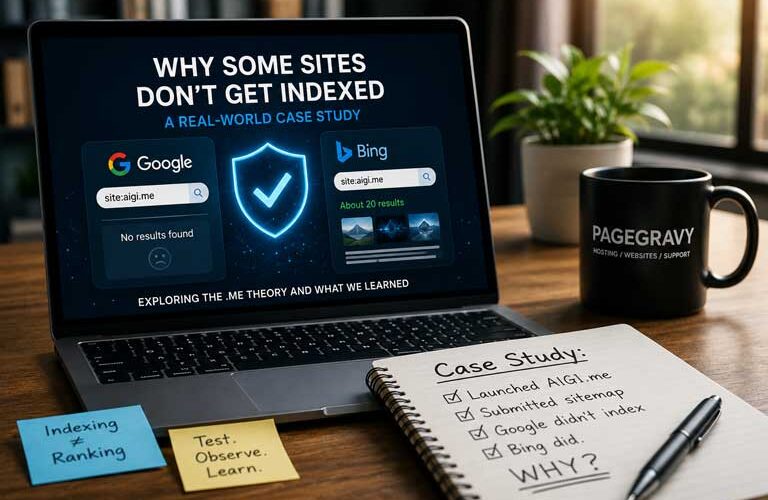
The homepage eventually appeared in Google, but the rest of the site did not follow the normal pattern. This was not a ranking concern — ranking takes time, and new sites need content, links, age, and trust before they perform well. Indexing is different. Indexing simply means Google has added the page to its search index. After manual submissions, sitemap submissions, and backlinks, the internal pages still were not showing the way we expected.
Was It a Coding Problem?
At first, we wondered if the issue was technical. A bad robots.txt file, a noindex tag, or a misconfigured canonical tag can all block search engines. So we looked at the common causes. The site was live, the homepage loaded correctly, the sitemap was available, the pages were linked, and Search Console said the URLs could be indexed. The site did not look broken — yet Google was not responding the way we expected.
Then We Checked Bing
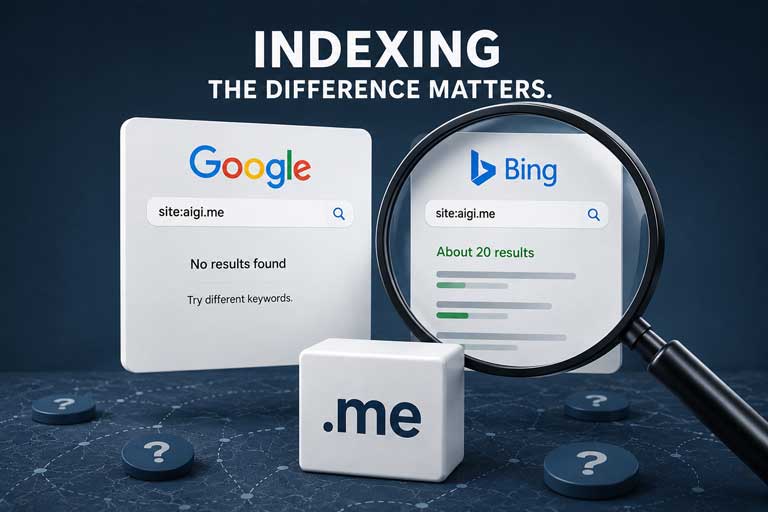
This is where the case study became more interesting. We had not submitted AIGI.me to Bing, added it to Bing Webmaster Tools, or requested indexing from Bing in any way. Even so, Bing found the site and had already indexed about 20 pages. That was an important discovery. If the site had a major coding issue, Bing would likely have struggled too. Instead, Bing found the pages on its own, and Bing AI also pulled up AIGI.me and understood the site as expected.
What Bing Helped Prove
Bing’s results helped rule out several possible problems. The site was crawlable, the pages could be found, the content could be read, and the website structure appeared to work. Because Bing indexed about 20 pages without any manual submission, the issue did not look like a basic website failure — which made the Google behavior even more unusual.
Could the .ME Extension Be Part of It?
One detail stood out: AIGI uses a .me domain name. Google has said that many domain extensions can rank and index like traditional domains, but real-world experience can sometimes feel different from official statements. After more than 20 years in web development and hosting, this was the first .me domain in our own launch experience that behaved this way. That does not prove .me caused the indexing delay, but it does make the extension worth testing. If the same website indexes quickly on another extension, that would be useful information. If the same problem happens again, then the issue is likely not the domain extension.
Why This Matters
Many business owners assume all domain extensions work the same way, and in many cases they may. However, indexing behavior matters when a new site launches. If Google delays indexing pages, the business loses time — and that matters even more for a new brand that needs search engines to find its pages and understand its topic. In this case, Bing found the site quickly. Google did not respond the same way.
What We Are Testing Next
We have now taken the next step. We registered aiverifiedimages.com and copied the same website over to it. The code is the same, the content is the same, and the hosting setup is as close as possible to the original. The only meaningful difference is the domain extension — .com instead of .me. Over the next few days, we will be watching how Google and Bing each respond to the new domain and comparing that behavior to what we saw with AIGI.me. If Google indexes aiverifiedimages.com significantly faster, that will tell us something worth publishing. If the results are similar, we will keep looking elsewhere.
What Website Owners Can Learn
This case is a reminder that indexing and ranking are not the same thing. A site can be well-built and still take time to rank, but indexing should usually happen first. When one search engine indexes a site quickly and another does not, it is worth paying attention. It does not always mean something is broken, but it may show that different search engines judge new websites in different ways. For website owners, that matters. For developers, it is worth testing. And for hosting providers, it is one more reason to watch DNS, server response, redirects, and domain choices closely.
Our Takeaway
We are not saying Google blocks .me domains, and we are not saying this case proves anything by itself. However, the launch behaved differently than expected. Bing indexed about 20 pages without being asked. Google was manually given the site and still lagged behind. That difference is hard to ignore. Now that aiverifiedimages.com is live with the same content, we have a real controlled test underway. As we watch both domains over the coming days, we will keep updating this case study with what we find. Either way, the lesson is simple: when a website does not behave like past launches, trust the data and keep testing.
About PageGravy, Inc.
PageGravy, Inc. is a digital solutions company based in Canton, Ohio, specializing in custom websites, mobile apps, and AI-powered tools. With nearly three decades of experience building on the web, the team at PageGravy helps businesses of all sizes bring their digital ideas to life — from smart chatbots and internal automation tools to full web application development. PageGravy also operates its own data centers and cloud infrastructure, giving clients fast, secure, and scalable hosting without the usual headaches. Projects like AIGI are built in-house, which is why real-world observations like this indexing case study matter to the team — they are not just developers, they are also the clients.